Leaders In Borehole Drilling In Kenya | +254 718 765 936 | info@antolinersystems.co.ke

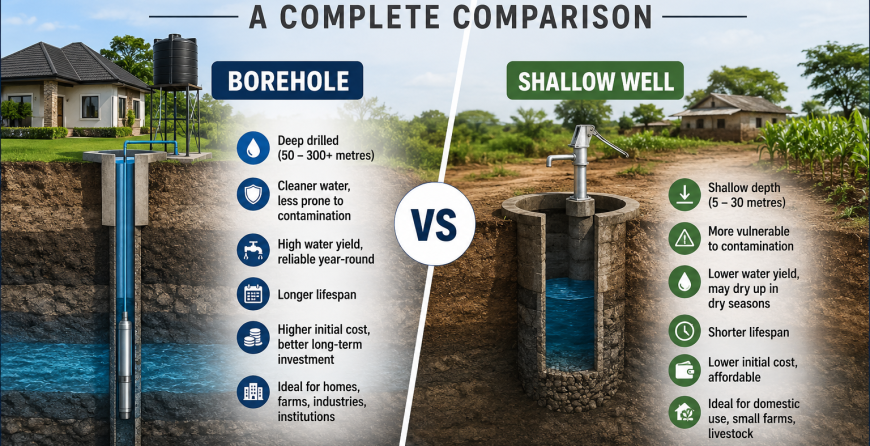
llustration comparing a borehole and a shallow well, highlighting differences in depth, water source, construction, water quality, cost, reliability, lifespan, and suitable applications.

Borehole vs Shallow Well: A Complete Comparison

Introduction

The debate of borehole vs shallow well has existed for decades and continues today. As the demand for reliable water in Kenya continues to grow across both urban and rural areas, more property owners are asking the same question: Which option is better, a borehole or a shallow well? Both are widely used groundwater sources, but selecting the right one requires an understanding of how each system works and the benefits it offers.

Although both systems provide access to groundwater, they are not the same. They differ in depth, construction methods, installation costs, water quality, water yield, and long-term reliability. Choosing the right option depends on factors such as your property’s geological conditions, water demand, budget, and long-term goals.

This comparison highlights the key differences between boreholes and shallow wells to help property owners make a practical and informed water investment decision.


What is a Borehole?

A borehole is a deep, narrow hole drilled into the ground to access groundwater stored in underground aquifers. Unlike a shallow well, a borehole is constructed using specialized drilling equipment to reach water-bearing rock formations beneath the surface. Once drilled, casing pipes are installed to protect the borehole and ensure efficient water extraction.

The depth of a borehole depends on the local geology and groundwater conditions. In Kenya, most productive boreholes range between 50 and 300 metres deep, although some may be shallower or deeper depending on the target aquifer.

Boreholes access groundwater from deep aquifers and use submersible pumps to bring water to the surface. They are widely used for residential, agricultural, commercial, industrial, and institutional water supply because they provide higher water yields and remain reliable even during prolonged dry seasons.


What is a Shallow Well?

A shallow well is a water source excavated or drilled to access groundwater found close to the ground surface. Unlike boreholes, shallow wells draw water from the upper water table, making them easier and less expensive to construct where groundwater is readily available.

Most shallow wells range between 5 and 30 metres deep, depending on the local water table and geological conditions. Water enters the well through natural seepage and is typically extracted using a bucket, hand pump, or electric pump.

Shallow wells are commonly used for domestic water supply, small-scale irrigation, and livestock watering. They are best suited for areas with abundant groundwater and low to moderate water demand.


Key Differences between a Borehole and a Shallow Well

Although boreholes and shallow wells both provide access to groundwater, they differ in several important ways. Understanding these differences can help property owners choose the most suitable water source based on their water requirements, budget, and the geological conditions of their location. The table below compares the key characteristics of a borehole and a shallow well.

Table 1: Key differences between a shallow well and a Borehole

Feature Borehole Shallow Well
Depth Typically 50–300 metres or more, depending on the aquifer. Typically 5–30 metres, depending on the water table.
Water Source Deep underground aquifers. Groundwater from the shallow water table.
Construction Method Drilled using specialized drilling rigs and equipment. Excavated manually or drilled using simple equipment.
Water Quality Generally cleaner due to natural filtration through deeper rock formations. More susceptible to contamination from surface activities.
Water Yield High and suitable for continuous, large-scale water demand. Moderate to low, depending on groundwater availability.
Reliability Reliable throughout the year, including during prolonged dry seasons. May experience reduced yields or dry up during droughts.
Lifespan Long service life when properly constructed and maintained. Generally shorter lifespan due to shallower depth and greater exposure to environmental conditions.
Risk of Contamination Lower risk because the water is protected by deeper geological layers. Higher risk from surface runoff, septic systems, agricultural chemicals, and other pollutants.
Maintenance Requirements Requires periodic pump servicing and water quality monitoring but generally less frequent structural maintenance. Requires regular cleaning, inspections, and protection against contamination.
Initial Cost Higher due to hydrogeological surveys, drilling, casing, and pump installation. Lower because of simpler construction methods and equipment.
Operating Costs Moderate, mainly electricity and pump maintenance. Low to moderate, depending on the pumping method used.
Suitable Applications Homes, apartments, farms, industries, schools, hospitals, hotels, and institutions with high water demand. Homes, small farms, livestock watering, gardens, and areas with low to moderate water demand.

The main difference between a borehole and a shallow well lies in the depth at which groundwater is accessed. Boreholes reach deep aquifers that typically provide cleaner, more reliable, and higher-yielding water supplies, making them ideal for long-term and high-demand applications. On the other hand, shallow wells are less expensive to develop and are suitable where groundwater is close to the surface, but they are generally more vulnerable to contamination and seasonal fluctuations in water availability. These differences should be carefully considered before investing in either groundwater system.


Advantages and Disadvantages of a Borehole

Boreholes are widely regarded as one of the most reliable groundwater sources for long-term water supply. Their ability to access deep aquifers allows them to produce consistent water yields in a wide range of environments. However, developing a borehole requires a significant financial investment and careful planning. Understanding both the advantages and disadvantages can help property owners determine whether a borehole is the right solution for their needs.

Advantages of a Borehole

Reliable Water Supply Throughout the Year

Boreholes access deep underground aquifers that are less affected by changing weather conditions. This allows them to provide a dependable water supply even during prolonged dry seasons when surface water sources and shallow wells may experience reduced yields.

Higher Water Yield

Most boreholes produce larger quantities of water than shallow wells, making them suitable for properties with high daily water demand. This is particularly beneficial for farms, industries, institutions, and large residential developments.

Better Water Quality

As groundwater travels through layers of soil and rock, many impurities are naturally filtered out before reaching the aquifer. As a result, borehole water is generally cleaner and less vulnerable to surface contamination than water from shallow wells. Water quality testing is still recommended to determine whether treatment is necessary.

Less Vulnerable to Seasonal Changes

Deep aquifers remain relatively stable throughout the year, allowing boreholes to maintain consistent water production even during periods of low rainfall. This makes them a reliable option in regions that experience recurring droughts.

Long Service Life

A properly designed and maintained borehole can remain productive for several decades. Regular maintenance of the pumping system and periodic water quality monitoring help extend its operational lifespan.

Suitable for Multiple Applications

Boreholes can supply water for a wide range of uses, including residential homes, commercial buildings, agricultural irrigation, livestock farming, industries, schools, hospitals, hotels, and other institutions that require a dependable water source.

Disadvantages of a Borehole

Higher Drilling Costs

Developing a borehole involves hydrogeological surveys, drilling, casing installation, well development, pump installation, and water quality testing. These activities make the initial investment significantly higher than constructing a shallow well.

Requires Specialized Equipment

Borehole drilling requires specialized drilling rigs, technical expertise, and experienced professionals. As a result, the project cannot be completed using simple excavation methods.

May Require Water Treatment

Although borehole water is generally of better quality, it may naturally contain minerals such as iron, manganese, fluoride, or excessive salinity depending on the geological formation. Water quality testing is essential to determine whether treatment is needed before the water is used for drinking or other purposes.

Longer Installation Process

The development of a borehole involves several stages, including hydrogeological investigations, drilling, casing installation, well development, test pumping, and pump installation. Completing all these processes usually takes longer than constructing a shallow well, especially in areas with challenging geological conditions.


Advantages and Disadvantages of a Shallow Well

Shallow wells provide a practical and cost-effective way of accessing groundwater where the water table is close to the surface. They are easier to construct than boreholes and can meet the water needs of households and small-scale users. However, their shallow depth makes them more vulnerable to contamination and seasonal changes. Understanding their advantages and disadvantages can help determine whether a shallow well is suitable for your property.

Advantages of a Shallow Well

Lower Construction Costs

Shallow wells are less expensive to develop because they require less excavation or drilling, simpler construction methods, and fewer specialized materials and equipment. This makes them an attractive option for property owners with limited budgets.

Faster to Construct

Compared to boreholes, shallow wells can usually be completed within a shorter period. The simpler construction process reduces both labor requirements and project timelines, allowing water to become available sooner.

Suitable Where Groundwater Is Close to the Surface

In areas with a high water table, shallow wells can provide an adequate and dependable water supply without the need for deep drilling. They are particularly effective in locations with favorable geological conditions and consistent groundwater recharge.

Easier Maintenance

Routine maintenance of a shallow well is generally straightforward. Cleaning, inspections, and minor repairs can often be carried out more easily than maintaining deep borehole systems, helping to keep maintenance costs relatively low.

Disadvantages of a Shallow Well

More Susceptible to Contamination

Because shallow wells draw water from the upper water table, they are more exposed to contamination from surface runoff, septic systems, agricultural chemicals, animal waste, and other pollutants. Proper siting, construction, and regular water quality testing are essential to reduce these risks.

Can Dry Up During Prolonged Dry Seasons

Shallow wells depend on groundwater found near the surface, making them more sensitive to seasonal fluctuations in rainfall. During extended dry periods, water levels may decline significantly, reducing water availability or causing the well to dry up completely.

Lower Water Yield

Most shallow wells produce less water than boreholes. Their output may be sufficient for domestic use or small-scale irrigation but may not meet the demands of large households, commercial facilities, or agricultural operations with high water consumption.

Shorter Lifespan

Shallow wells generally have a shorter service life than boreholes due to their exposure to environmental conditions, sediment buildup, and a greater risk of contamination. Regular maintenance can improve their longevity, but they typically require more frequent rehabilitation.

Not Ideal for High Water Demand

Properties with continuous or high-volume water requirements may quickly exceed the capacity of a shallow well. For such applications, a borehole is often a more reliable long-term solution because it can provide higher and more consistent water yields.


How a Borehole is Developed

Developing a borehole involves a series of carefully planned technical stages designed to locate a productive aquifer and ensure a safe, reliable, and long-lasting water supply. The process typically begins with a hydrogeological survey and site selection, followed by borehole drilling, casing installation, gravel packing, well development, test pumping, water quality testing, and finally pump installation.

Each stage plays an important role in determining the borehole’s performance, water quality, and lifespan. A professionally developed borehole is more likely to provide a consistent water supply while minimizing the risk of structural failure and contamination. For a detailed explanation of each stage, read our comprehensive guide on the borehole drilling process.


How a Shallow Well is Developed

Constructing a shallow well involves a relatively simple process compared to borehole development. The construction typically begins with selecting a suitable site where the groundwater table is close to the surface. The well is then excavated or drilled to the required depth, after which lining materials are installed to stabilize the walls and prevent collapse. Depending on the design, a bottom filter may be added to reduce sediment entry before a suitable pump is installed.

Once construction is complete, the water should be tested to determine its quality and suitability for the intended use. Proper site selection, construction, and regular maintenance are essential to improve the well’s performance, reduce the risk of contamination, and extend its service life.


Borehole vs Shallow Well: Which is Better?

There is no one-size-fits-all answer when comparing a borehole vs shallow well. The better option depends on factors such as groundwater availability, your property’s water requirements, budget, geological conditions, and long-term plans. Understanding your specific needs will help you choose the most practical and cost-effective solution.

Choose a Borehole If:

A borehole is generally the better option if:

  • You need a reliable water supply throughout the year.
  • Your property has high water demand, such as for irrigation, commercial operations, or large households.
  • Your area experiences frequent droughts or seasonal water shortages.
  • You are looking for a long-term investment with a dependable water source.
  • You want access to deeper groundwater that is generally less susceptible to contamination.

Choose a Shallow Well If:

A shallow well may be the right choice if:

  • Groundwater is available close to the surface.
  • You have a limited budget for water development.
  • Your water demand is relatively low, such as for a single household or small-scale farming.
  • The water source is intended for seasonal or occasional use.
  • Local geological conditions are suitable for shallow groundwater abstraction.

Ultimately, the best choice depends on your property’s conditions and water needs. Consulting a qualified hydrogeologist before beginning any groundwater project can help determine the most suitable and cost-effective option for your location.


Factors to Consider Before Choosing Between a Borehole and a Shallow Well

Selecting between a borehole and a shallow well involves more than comparing construction costs. Several environmental, technical, and financial factors influence the suitability and long-term performance of each option. Evaluating these factors before starting your project can help you make a well-informed investment.

Groundwater Availability

The availability and depth of groundwater are among the most important considerations. Areas with a high water table may be suitable for shallow wells, while locations where groundwater occurs at greater depths typically require a borehole. Understanding local groundwater conditions helps determine the most appropriate water source.

Water Demand

Consider how much water you need on a daily basis. A shallow well may be sufficient for a single household or small-scale irrigation, whereas a borehole is better suited for properties with high water demand, including farms, commercial buildings, industries, schools, and residential developments.

Budget

Your available budget will influence the type of groundwater system you can develop. Shallow wells generally have lower construction costs, while boreholes require a higher initial investment due to hydrogeological surveys, drilling, casing installation, and pump installation. However, a borehole may offer better long-term value because of its reliability and higher water yield.

Water Quality

Groundwater quality can vary depending on the location and depth of the water source. Boreholes often produce cleaner water because it has been naturally filtered through deeper geological formations, while shallow wells are more vulnerable to contamination from nearby human activities. Regardless of the source, water quality testing should always be carried out before the water is used.

Property Location

The location of your property plays a significant role in determining the best option. Factors such as climate, rainfall patterns, surrounding land use, and the proximity of potential contamination sources can affect groundwater availability and water quality.

Soil and Geological Conditions

Different soil types and rock formations influence groundwater storage and movement. A hydrogeological investigation helps determine whether your site is suitable for a shallow well or if drilling a borehole is necessary to reach a productive aquifer.

Long-Term Maintenance

Both systems require maintenance, but the type and frequency differ. Shallow wells may require more frequent cleaning and monitoring to reduce contamination risks, while boreholes generally require periodic servicing of pumps and routine water quality testing. Considering long-term maintenance costs can help you choose a system that fits your operational needs.

Professional Hydrogeological Assessment

Consulting a qualified hydrogeologist before developing any groundwater source is highly recommended. A professional assessment evaluates groundwater potential, geological conditions, expected water yield, and the most suitable development method. This reduces the risk of unsuccessful drilling or constructing a water source that does not meet your long-term needs.


Frequently Asked Questions

What is the main difference between a borehole and a shallow well?

The main difference is the depth at which groundwater is accessed. A borehole is drilled deep into underground aquifers, often between 50 and 300 metres or more, while a shallow well accesses groundwater found close to the surface, typically between 5 and 30 metres deep. As a result, boreholes generally provide more reliable water supplies and higher water yields than shallow wells.

Is a borehole more expensive than a shallow well?

Yes. Developing a borehole usually costs more because it involves a hydrogeological survey, specialized drilling equipment, casing installation, well development, test pumping, and pump installation. A shallow well is generally less expensive to construct due to its simpler excavation or drilling process.

Which provides cleaner water?

In most cases, boreholes provide cleaner water because groundwater from deep aquifers is naturally filtered through layers of soil and rock before reaching the borehole. Shallow wells are more vulnerable to contamination from surface runoff, septic systems, agricultural activities, and other nearby pollution sources. Regardless of the water source, water quality testing should always be conducted before use.

Can a shallow well dry up?

Yes. Shallow wells depend on groundwater near the surface, making them more susceptible to seasonal fluctuations in rainfall. During prolonged dry seasons or droughts, the water table may drop, causing the well to produce less water or dry up completely.

How deep should a borehole be?

There is no standard depth for every borehole. The required depth depends on local geological conditions and the location of productive aquifers. In Kenya, many productive boreholes range between 50 and 300 metres or more, although some may be shallower or significantly deeper depending on the hydrogeological conditions.

Which option lasts longer?

A properly constructed and maintained borehole generally has a longer lifespan than a shallow well. Boreholes can remain productive for several decades because they access deeper, more stable aquifers and are less exposed to environmental conditions. Shallow wells typically have a shorter lifespan due to their greater susceptibility to contamination, sediment buildup, and seasonal changes in groundwater levels.


Conclusion

When comparing a borehole vs shallow well, there is no universally better option. Both groundwater sources have distinct advantages and limitations, and the right choice depends on your property’s groundwater conditions, water demand, budget, and long-term objectives. Boreholes are ideal for properties that require a reliable, high-yield water supply throughout the year, while shallow wells offer a more affordable solution where groundwater is readily available near the surface.

Before investing in either option, it is advisable to conduct a professional hydrogeological assessment to determine the most suitable groundwater source for your location. Making an informed decision will help ensure a dependable water supply, protect your investment, and meet your property’s water needs for years to come.

Need expert advice on choosing between a borehole and a shallow well?

Contact Antonliner Systems Limited for professional hydrogeological surveys, borehole drilling, shallow well construction, water quality testing, and groundwater development services. Our experienced team will help you identify the best water solution for your property and ensure your investment delivers reliable, long-term results.

Leave Your Reply

Your email address will not be published.

*